Research Article | | Peer-Reviewed

Development of a Whole-Cell Biocatalytic System for Lycopene Production in Escherichia coli

Received: 10 March 2026     Accepted: 20 March 2026     Published: 2 April 2026
Views:       Downloads:
Abstract

Lycopene is one of the most well-known carotenoids in nature due to its high antioxidant properties and wide health benefits. Due to a wide range of applications in food, nutraceuticals, cosmetics, and pharmaceuticals, demand for lycopene has grown significantly and its unmet need requires production at large scale. Conventionally, lycopene extraction from natural sources suffers from extensive downstream processing and poor yield. Industrial processes using tomato pomace or peels can achieve somewhat higher concentrations, but overall yields remain modest compared with the demand for nutraceutical?grade lycopene. Therefore, the development of alternative process including microbial based production of lycopene are being explored. Escherichia coli stands out as a preferred host due to its rapid growth, well-characterized genetics, and amenability to engineering. It can grow on cheap carbon sources such as glucose, glycerol, or agricultural waste, which lowers production costs for bio?based chemicals and natural products. In this study, we engineered E. coli for whole-cell biocatalytic lycopene production using a two-plasmid system. We co-expressed enzymes from the mevalonate pathway to boost isoprenoid precursors, alongside lycopene biosynthetic genes (e.g., crtE, crtB, crtI) that channel these intermediates into lycopene. This platform converts glucose directly into lycopene through multi-step biosynthesis, bypassing extraction bottlenecks. Our approach highlights E. coli's potential as an efficient, sustainable biocatalyst for industrial carotenoid production.

Published in Advances in Bioscience and Bioengineering (Volume 14, Issue 1)
DOI 10.11648/j.abb.20261401.12
Page(s) 7-16
Creative Commons

This is an Open Access article, distributed under the terms of the Creative Commons Attribution 4.0 International License (http://creativecommons.org/licenses/by/4.0/), which permits unrestricted use, distribution and reproduction in any medium or format, provided the original work is properly cited.

Copyright

Copyright © The Author(s), 2026. Published by Science Publishing Group

Keywords

Synthetic Biology, Whole-Cell Biocatalysis, Lycopene, Mevalonate Biosynthetic Pathway, Isoprenoid Biosynthesis

1. Introduction
Carotenoids are important with aspect to human health and nutrition. It consists of an aliphatic C40 molecules with high level of conjugated double bonds with additional properties that includes light absorption and capturing light for photosynthesis , nutraceuticals and food colouring agent . Lycopene is a naturally occurring carotenoid compound that has gained significant attention due to its extensive applications in the food, pharmaceutical, and cosmetic industries. Its potent biological activities, including anti-cancer , anti-inflammatory , and antioxidant effects , contribute to its prominence as a functional bioactive molecule.
The search for effective and sustainable lycopene production methods has been driven by the recent interest in natural food additives . Plant biomass is the main source of lycopene because of its high content in plants, especially tomatoes, which are rich in lycopene, readily available and relatively inexpensive. However, there are several limitations regarding the extraction process because consumption of organic solvent is much higher, specificity of the process is poor and causes harm to the environment . Although chemical synthesis overcomes limitations associated with seasonal variability and raw material supply, it remains economically unviable due to high costs, low yields, and environmental concerns, and is currently banned in several European countries. In contrast, microbial biosynthesis has emerged as a promising alternative, offering a sustainable, scalable, and environmentally friendly approach . Advances in metabolic engineering and synthetic biology has potential to revolutionize the lycopene production in microorganisms, positioning microbial fermentation as a viable solution to meet increasing industrial and market demands.
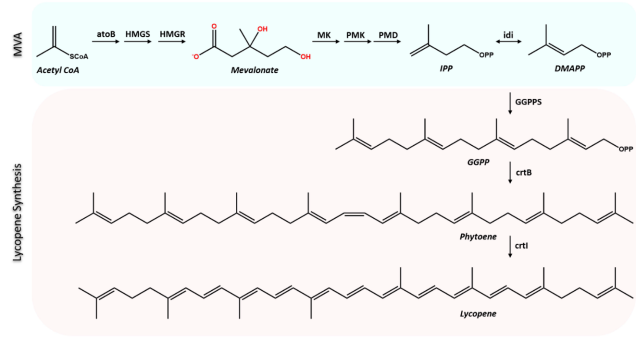
Lycopene, a linear carotenoid with a C40 carbon structure, is made up of seven isopentenyl diphosphates (IPP) and one dimethylallyl diphosphate (DMAPP), which are its biosynthetic building blocks . The formation of IPP and its isomer, DMAPP, takes place in vivo through either the 2-C-methyl-d-erythritol-4-phosphate (MEP) pathway or the mevalonate (MVA) pathway, as documented . The MEP pathway, which is present in a variety of bacteria, algae, cyanobacteria, plant chloroplasts, and certain eukaryotic parasites , starts with the condensation of pyruvate and glyceraldehyde 3-phosphate, both of which are products of glycolysis . On the other hand, the MVA pathway, found in most eukaryotes, fungi, plants, archaea, and some bacterial species, begins with acetyl-CoA as the initial substrate to synthesize IPP and DMAPP . Moreover, IPP and DMAPP are used in the synthesis of geranylgeranyl diphosphate (GGPP) . Two molecules of GGPP are condensed into phytoene through phytoene synthase (CrtB) and are further desaturated through phytoene desaturase/lycopene synthase (CrtI) into lycopene . The lycopene biosynthetic pathway is described in the Figure 1 given below.
Figure 1. Schematic representation of lycopene biosynthetic route.
Reprogramming Escherichia coli MG1655 (DE3) for the biosynthesis of secondary metabolites and high-value chemicals through metabolic engineering further facilitate scalable biocatalysis to meet the growing demand for natural products in functional foods and therapeutics . Terpenoids can be produced by the native MEP pathway in E. coli, such as lycopene; however, its pathway has a limited metabolite flux . Therefore, an alternative source for the MVA pathway can be expressed in E. coli for increased production of lycopene. In a study done by , they engineered Y. lipolytica to produce lycopene by using short-chain fatty acids (acetate, butyrate and propionate) as an alternative to carbon source. They integrated P. agglomerans derived lycopene biosynthetic genes (crtE, crtB, crtI) into a single genomic locus along with idi gene overexpression and strengthened phospholipid biosynthesis. The idi gene encodes (E)-4-hydroxy-3-methylbut-2-enyl pyrophosphate reductase (also called isopentenyl-diphosphate δ-isomerase or IDI), a key enzyme in the MEP (methylerythritol phosphate) pathway for isoprenoid biosynthesis. It resulted in high lycopene production with up to 462.9 mg/g dry cell weight and 3.41 g/L under simple flask cultivation method . In another study performed by , they enhanced lycopene synthesis by 1.7-fold in E. coli with comparison to control strain that expressed free enzymes. They devised a strategy by linking IPP synthetic enzymes (ScCK-AtIPK-MaxnIDI) on carboxysome protein cages using SC/ST methods. In the mCherry-labeled carboxysome shell (CBs-mCherry-SC, where SC = SpyCatcher) and mGFP-ST (ST = SpyTag) co-expression, SpyTag on the cargo fuses covalently to SpyCatcher on the shell exterior post-induction, enabling targeted protein immobilization and visualization of assembly (e.g., co-localized red/green fluorescence). This avoids random attachment, preserving enzyme orientation for biocatalysis like lycopene pathway enhancement. They claim carboxysome cells as an ideal scaffold for designing tailored multi-enzyme assemblies .
In this study, we used optimised mevalonate pathway genes for increased isoprenoid precursor pools and flux directed toward the downstream pathway genes under the influence of T7 promoter to produce lycopene in E. coli. The plasmid pJBEI-6409 carries mevalonate pathway genes atoB, HMGS and HMGR converts glucose molecules under PlacUV5 promoter to produce mevalonate which is then further sequentially phosphorylated by two kinases MK and PMK to generate isoprenoid pools such as dimethylallylpyrophosphate (DMAPP) and isopentenylpyrophosphate (IPP). The heterologous mevalonate (MEV) pathway genes were incorporated into p15A vector backbone along with terpene synthases for limonene synthesis. Therefore, we attempted to delete the truncated geranylpyrophosphate (trGPPS) that catalyses a C10 chain by condensing two isoprenoid precursor molecule head to tail and limonone synthase (LS) that cyclise a C10 chain into limonene and perillyl alcohol. By removing trGPPS and LS, we tried to increase the isoprenoid pools by overproducing IPP and DMAPP and reroute this flux by introducing another plasmid carrying lycopene biosynthetic pathway genes (GGPPS, crtI, crtB and ipi) to produce lycopene by accepting isoprenoid precursors IPP and DMAPP as a substrate.
2. Methodology
2.1. Strains, Plasmids, and Genes
Escherichia coli MG1655 (DE3) was used as the host strain for heterologous pathway expression and metabolite production, and E. coli DH5α was used for routine molecular cloning. The bacterial strains, plasmids and associated genes used in this study are described in Table 1 and Table 2 respectively.
Table 1. List of strains and plasmids.

Strain/Plasmid

Description

Reference

MG1655 (DE3)

ΔendA ΔrecA (λ DE3)

-

DH5α

fhuA2 Δ(argF-lacZ)U169 phoA glnV44 Φ80 Δ(lacZ)M15 gyrA96 recA1 relA1 endA1 thi-1 hsdR17

-

pJBEI-6409

p15A, CmR, PlacUV5, atoB, HMGS, HMGR, PlacUV5, mvk, PMK, PMD, idi, Ptrc, trGPPS, ls

pJBEI-6409 ΔtrGPPS ΔLS

p15A, CmR, PlacUV5, atoB, HMGS, HMGR, PlacUV5, mvk, PMK, PMD, idi

This study

p5T7-LYCipi-ggpps

pSC101, SpR, PT7lacUV, ggpps, ipi, crtI, crtB

Table 2. List of genes used in this study and their origin.

Genes

Origin (Accession Number)

ggpps

Taxus canadensis (AAD16018.1), codon optimized, truncated first 98 amino acids, methionine added

crtI

AFZ89042.1

crtB

AFZ89043.1

ipi

AAA64978.1

LS

Mentha spicata (AAC37366.1), codon optimized

gpps

Abies grandis (AAN01134.1), codon optimized

ispA

E. coli (WP_097750737.1)

idi

E. coli (AAD26812.1)

atoB

E. coli (NC_000913.3)

HMGS

Staphylococcus aureus

HMGR

Staphylococcus aureus

MK

Saccharomyces cerevisiae

PMK

Saccharomyces cerevisiae

PMD

Saccharomyces cerevisiae

Plasmid pJBEI-6409 available in Addgene (#47048), encoding a heterologous mevalonate pathway, and plasmid p5T7-LYCipi-ggpps available in Addgene (#122017), encoding lycopene biosynthesis enzymes, were obtained from Taek Soon Lee and Gregory Stephanopoulos, respectively .
Plasmid pJBEI-6409 encodes a heterologous mevalonate pathway and downstream terpene biosynthetic genes that enable limonene production from glucose in Escherichia coli. The genes atoB, HMGS, and HMGR, expressed from the PlacUV5 promoter, convert glucose-derived metabolites into mevalonate, while MK, PMK, PMD, and idi, driven by the Ptrc promoter, subsequently convert mevalonate to the isoprenoid precursors dimethylallyl pyrophosphate (DMAPP) and isopentenyl pyrophosphate (IPP). Upon introduction of trGPPS and LS under control of the Ptrc promoter, IPP and DMAPP are condensed and cyclized to form limonene .
Deletion of the genes encoding trGPPS and limonene synthase was performed to redirect carbon flux toward the accumulation of dimethylallyl pyrophosphate (DMAPP) and isopentenyl pyrophosphate (IPP). The resulting engineered plasmid was designated pJBEI-6409 ΔtrGPPS ΔLS.
Plasmid p5T7-LYCipi-ggpps carries a geranylgeranyl pyrophosphate synthase (GGPPS) gene from Taxus canadensis, a homolog of crtE that converts IPP and DMAPP to geranylgeranyl pyrophosphate (GGPP), together with crtI, crtB and ipi from Pantoea agglomerans, which encode the downstream enzymes required for lycopene biosynthesis .
2.2. Co-Transformation in Escherichia coli
Chemically competent Escherichia coli cells were thawed on ice for 30 min following retrieval from a −80°C freezer. Each plasmid DNA (100 ng) was added to the thawed cells in a microcentrifuge tube, gently mixed by flicking, and incubated on ice for 30 min to promote DNA uptake. The mixture underwent heat shock at 42°C for 90 s, followed by immediate ice cooling for 5 min.
Pre-warmed LB medium (750 µL) was added to the cells as it dilutes stressed cells ~15–37-fold into nutrient-rich medium, minimizing toxicity from residual ions/DNA while providing ample nutrients for 45–60 min outgrowth at 37°C/200 rpm and also to enable antibiotic resistance gene expression. Aliquots (50–200 µL) of the recovery culture were spread on LB agar plates supplemented with chloramphenicol (25 µg/mL) and spectinomycin (50 µg/mL), then incubated overnight at 37°C to select transformants.
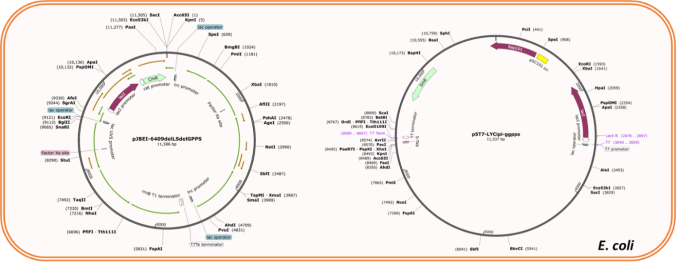
Figure 2. Co-transformation strategy showing pJBEI-6409 ΔtrGPPS ΔLS and p5T7-LYCipi-ggpps in E. coli.
pJBEI-6409 (Addgene #47048), a BglBrick plasmid encoding the mevalonate (MEV) pathway including codon-optimized truncated geranyl pyrophosphate synthase (trGPPS) and limonene synthase (LS) under Ptrc promoter control, was digested with KpnI and SacI restriction enzymes. A PCR-amplified DNA fragment spanning the BamHI-SacI region, flanked by KpnI and SacI sites, was ligated into the linearized vector. The resulting construct, pJBEI-6409ΔLSΔGPPS, lacks the full LS and GPPS genes, retaining only the first ~60 amino acids of the truncated GPPS. The co-transformation strategy including plamids pJBEI-6409ΔLSΔGPPS and p5T7-LYCipi-ggpps in E. coli are shown in the Figure 2.
2.3. Cultivation at Analytical Scale
For analytical-scale cultivation, a single colony was used to inoculate 5 mL LB medium and grown at 37 °C for 18 h. The resulting overnight culture was used to inoculate 100 mL M9 minimal medium (33.7 mM Na₂HPO₄, 22.0 mM KH₂PO₄, 8.55 mM NaCl, 9.35 mM NH₄Cl) supplemented with 20% (w/v) glucose, 1 mM MgSO₄, 0.3 mM CaCl₂, and thiamine (1 µg), at an inoculation ratio of 1% (v/v) supplemented with chloramphenicol (25 µg/mL) and spectinomycin (50 µg/mL). The culture was incubated at 37 °C and 200 rpm for 8 h, after which protein expression was induced at an optical density at 600 nm (OD₆₀₀) of 1.0 by addition of isopropyl β-D-1-thiogalactopyranoside (IPTG) to a final concentration of 0.1 mM, followed by incubation at 37°C and 200 rpm for 120 h.
2.4. Cultivation at Preparative Scale
For preparative-scale cultivation, a single colony was used to inoculate 40 mL LB medium and grown at 37 °C for 18 h. The resulting overnight culture was used to inoculate 4 L M9 minimal medium (33.7 mM Na₂HPO₄, 22.0 mM KH₂PO₄, 8.55 mM NaCl, 9.35 mM NH₄Cl) supplemented with 20% (w/v) glucose, 1 mM MgSO₄, 0.3 mM CaCl₂, and thiamine (1 µg) supplemented with chloramphenicol (25 µg/mL) and spectinomycin (50 µg/mL), at an inoculation ratio of 1% (v/v) in shake flask. The culture was incubated at 37 °C and 200 rpm for 8 h, after which protein expression was induced at an optical density at 600 nm (OD₆₀₀) of 1.0 by addition of isopropyl β-D-1-thiogalactopyranoside (IPTG) to a final concentration of 0.1 mM, followed by incubation at 37°C and 200 rpm for 120 h and cell density was monitored by UV/Vis spectroscopy at 600 nm.
Furthermore, this preparative scale was also performed in 10 L fermenter where 40 ml LB medium containing cells was added in a 4 L M9 minimal medium (33.7 mM Na₂HPO₄, 22.0 mM KH₂PO₄, 8.55 mM NaCl, 9.35 mM NH₄Cl) supplemented with 20% (w/v) glucose, 1 mM MgSO₄, 0.3 mM CaCl₂, and thiamine (1 µg) supplemented with chloramphenicol (25 µg/mL) and spectinomycin (50 µg/mL). The culture condition optimised for fermenter scale production as 0.3 to 1 volume of air per volume of liquid per minute of aeration and 250 to 1250 rpm of agitation were controlled by a cascade to maintain dissolved oxygen at 40% saturation and 25% vol/vol NH4OH was used to control pH. UV/Vis spectroscopy was used to monitor cell density.
3. Results and Discussion
3.1. Construction and Modular Engineering of the Mevalonate Pathway and Lycopene Biosynthetic Pathways
Our strategy for reconstructing the lycopene biosynthetic pathway is guided by three key reports that defined efficient frameworks for microbial production of lycopene. provided key insights into upper mevalonate pathway operon, which includes heterologous expression of atoB-an acetyl-CoA thiolase from Escherichia coli-in combination with HMGS, an HMG-CoA synthase from Saccharomyces cerevisiae, and HMG-CoA reductase (HMGR). This module enables endogenous acetyl-CoA channeling toward mevalonate synthesis. Thus, bypassing the intrinsic flux limitations of the native bacterial MEP pathway. The assembly of the lower mevalonate pathway, wherein mevalonate is converted to the universal isoprenoid precursors isopentenyl pyrophosphate (IPP) and dimethylallyl pyrophosphate (DMAPP), was inspired by key findings in the reported literature. In particular, the results of indeed showed higher lycopene production via the Streptococcus pneumoniae pathway variant, while provided insights into modular optimization of isoprenoid biosynthesis. Further strengthening of pathway flux was achieved by expressing the biosynthetic genes of downstream lycopene under the high-performance T7 promoter system. Many reports have in fact documented significant productivity advances due to its introduction in an engineered high-expression strain background. With this approach, therefore, a high-flux biosynthetic pathway has been developed which could support efficient lycopene synthesis.
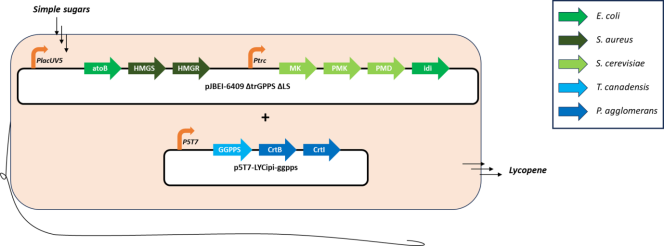
Building on the foundation discussed above, we integrated optimized upper mevalonate pathways gene and downstream lover mevalonate pathway gene for synthesis of precursor from the central carbon supply. Accordingly, we chose plasmid pJBEI-6409, a p15A-origin vector encoding a codon-optimized mevalonate (MEV) pathway for terpenoid production. We modified by precise excision of the truncated geranyl pyrophosphate synthase (trGPPS) and limonene synthase (LS) genes. This targeted removal prevents early diversion of isoprenoid precursors (IPP and DMAPP) into monoterpene synthesis, thereby expanding the upstream precursor pool available for downstream carotenoids. The plasmid pJBEI-6409 ΔtrGPPS ΔLS and p5T7-LYCipi-ggpps, a high-copy T7 promoter plasmid expressing lycopene biosynthetic genes (crtI, crtB, ipi from Pantoea agglomerans and ggpps from Thermotoga canadiensis) was co-transformed into E. coli as described in Figure 3.
Figure 3. The heterologous mevalonate (MVA) pathway and lycopene biosynthetic pathway introduced into E. coli to produce lycopene. The MVA pathway utilises acetyl-CoA derived from glucose to produce isoprenoid metabolites. IPP, Isopentenylpyrophosphate; DMAPP, Dimethylallypyrophosphate; GGPP, Geranylgeranylpyrophosphate.
3.2. Whole Cell Biocatalytic Synthesis of Lycopene
After successfully establishing the modular mevalonate and carotenoid pathways described above, we next reprogrammed the E. coli strains for lycopene bioproduction. To address regulatory limitations of the native MEP pathway, integration of upper and lower mevalonate modules was performed. A dual-plasmid approach was implemented to optimize the conversion of acetyl-CoA to the C40 backbone. We redirected metabolic flux from the central carbon stuff to increase useful carotenoids, targeting mainly the production of lycopene. Two plasmids have been co-transformed with mevalonate-pathway genes to enhance the isoprenoid IPP/DMAPP production and other essential genes in the downstream pathway like GGPPS, phytoene synthase, and phytoene desaturase. We have channelized the metabolic flux efficiently from central carbon metabolism to prioritize the production of lycopene.
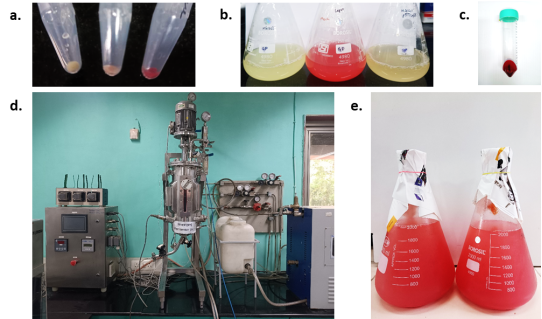
Chemical transformation was used to transform both engineered plasmids harbouring MVA and lycopene pathways genes described above into E. coli competent cells for the implementation of the biotransformation system. The recombinant strains were grown in shake flasks to produce lycopene. A total of 100-hour fermentation was conducted, and the progress of fermentation was monitored through the increase of the red pigment in the culture as shown in Figure 4.
Figure 4. a) The red pigmentation confirms the production of lycopene in E. coli MG1655 incorporating plasmids pJBEI-6409 ΔtrGPPS ΔLS and p5T7-LYCipi-ggpps(right) with respect to control E. coli MG1655 carrying plasmid p5T7-LYCipi-ggpps (middle) and E. coli MG1655 (left) devoid of both plasmids. b) Culture after 120 hours of E. coli MG1655 incorporating plasmids pJBEI-6409 ΔtrGPPS ΔLS and p5T7-LYCipi-ggpps(middle) with respect to control E. coli MG1655 carrying plasmid p5T7-LYCipi-ggpps (right) and E. coli MG1655 (left) devoid of both plasmids. c) Cell pellet of the whole-cell culture containing lycopene metabolite. d) Pilot scale of 4 L lycopene culture in a 10 L scale fermenter unit present in CSIR-CDRI facility. e) Collected 4 L lycopene culture in two 2 L flask.
Samples were taken at regular intervals during fermentation for extraction and measurement which has allowed us to determine the kinetics of lycopene production. The accumulation of lycopene was monitored through increased red coloration of culture, indicating higher activity of the MEV pathway and that GGPPS effectively converted IPP/DMAPP into longer isoprenoid chains, which was then desaturated and isomerized by CrtB/CrtI.
This approach decouples precursor supply from competing sinks while utilizing the well-established high-performance MEV upper pathway in pJBEI-6409 and is in consistent with previous optimizations that enhanced terpenoid titers by stoichiometric pathway balancing.
3.3. Quantification of Lycopene
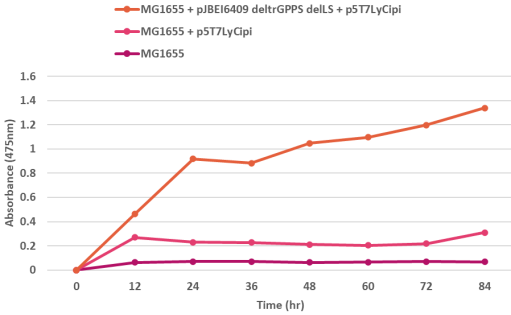
The quantification of lycopene content in E. coli was done by UV-Vis spectrophotometry at 475 nm. Cultures were sampled by transferring 1 mL at different time intervals to amber microtubes to prevent photodegradation, followed by centrifugation at 14000 rpm for 10 min to pellet cells. Pellets were resuspended in 1 mL of 50% (v/v) ethanol: 50% (v/v) acetone extraction solvent and vortexed for 30 min to disrupt cells and solubilize lycopene. Cell debris was removed by centrifugation, and 200 μL of clarified supernatant was loaded into a 96-well microplate for absorbance measurement. (Chatzivasileiou et al., 2019) The absorbance at 475 nm for lycopene production is shown in Figure 5.
Figure 5. Lycopene production assessed by UV/Vis spectrophotometer at 475 nm at different time intervals. Absorption of lycopene in E. coli MG1655 strain harbouring pJBEI6409 ΔtrGPPS ΔLS and p5T7-LYCipi-ggpps was recorded between 1.2-1.4 as compared to E. coli MG1655 strain harbouring only p5T7-LYCipi-ggpps and E. coli MG1655 strain between 0.2-0.4 and 0-0.2 upto 84 hours.

As compared with control E. coli MG1655 (p5T7LYCipi) and E. coli MG6155, the strain E. coli MG1655 (pJBEI-6409 ΔtrGPPS ΔLS and p5T7-LYCipi-ggpps) showed absorption value of 0, 0.192, 0.689, 0.655, 0.836, 0.893, 0.979 and 1.031 at 0h, 12 h, 24 h, 36 h, 48 h, 60 h, 72 h, and 84 h respectively. This estimated to be much higher than E. coli MG1655 (p5T7LYCipi) that utilises isoprenoid produced from basal expression of mevalonate pathway to synthesise lycopene.
4. Conclusion
A microbial biocatalyst based on recombinant Escherichia coli for the biosynthesis of lycopene from glucose was successfully constructed. By employing a modular approach to metabolic engineering, we co-expressed mevalonate (MVA) pathway gene along with lycopene biosynthesis gene for the production lycopene. We integrated the optimized upper mevalonate pathways genes consisting of atoB, HMGS, and HMGR, with high-efficiency lower mevalonate pathways genes (MK, PMK, PMD, IDI) to achieve efficient synthesis of isoprenoid precursors (IPP and DMAPP) synthesis. By incorporating a plasmid with mevalonate pathway genes responsible for producing the isoprenoid precursors and redirecting that flux to the lycopene biosynthesis pathway genes located on a different plasmid with GGPPS, CrtB, and CrtI, metabolic flux was indeed diverted toward the biosynthesis of lycopene. These results represent the ability to combine module-by-module pathway development with recently developed synthetic biology strategies to overcome some of the challenges currently faced in biomanufacturing. Dynamic regulation and adaptation are expected to offer significant opportunities for the optimization of lycopene biosynthesis and the expansion of microbial sustainable platforms in the near future.
Abbreviations

DMAPP

Dimethylallyl diphosphate (dimethylallyl pyrophosphate)

GGPP

Geranylgeranyl Diphosphate (Geranylgeranyl Pyrophosphate)

GGPPS

Geranylgeranyl Diphosphate Synthase

IPP

Isopentenyl Diphosphate (Isopentenyl Pyrophosphate)

MVA

Mevalonate Pathway

MEP

2‑C‑methyl‑d‑erythritol‑4‑phosphate pathway

MEV

Mevalonate (MVA) Pathway Module in Plasmid

T7

T7 Bacteriophage Promoter System

PlacUV5

Hybrid lac‑UV5 promoter

Ptrc

T7‑lac hybrid promoter

IPTG

Isopropyl β‑D‑1‑thiogalactopyranoside

OD600

Optical density at 600 nm

LB

Luria–Bertani (Luria–Broth) medium

MG1655

Escherichia coli K‑12 wild‑type strain MG1655

DH5α

E. coli cloning strain DH5α

pJBEI‑6409

p15A‑based plasmid encoding full MVA and downstream terpene genes

pJBEI‑6409 ΔtrGPPS ΔLS

Engineered variant of pJBEI‑6409 lacking truncated GPPS and limonene synthase

p5T7‑LYCipiggpps

pSC101‑based T7‑promoter plasmid encoding lycopene pathway genes (ipi, crtI, crtB, ggpps)

GGPPS

Geranylgeranyl Diphosphate Synthase (from Taxus canadensis)

crtB

Phytoene Synthase (from Pantoea agglomerans)

crtI

Phytoene Desaturase / lycopene synthase (from Pantoea agglomerans)

ipi

Isopentenyl‑diphosphate isomerase (idi‑like gene from Pantoea agglomerans)

trGPPS

Truncated Geranyl Diphosphate Synthase

LS

Limonene Synthase

MVK / MK

Mevalonate Kinase

PMK

Phosphomevalonate Kinase

PMD

Pyrophosphomevalonate Decarboxylase

HMGS

HMG‑CoA Synthase

HMGR

HMG‑CoA Reductase

atoB

Acetyl‑CoA Thiolase (from E. coli)

idi

Isopentenyl‑diphosphate Isomerase (native E. coli gene)

Acknowledgments
Gaurav Prajapati acknowledges the Council of Scientific and Industrial Research, India (CSIR) for providing the Senior Research fellowship (31/0004(16435)/2023-EMR-I), CSIR-Central Drug Research Institute, Lucknow, Uttar Pradesh 226031 India and Academy of Scientific and Innovative Research (AcSIR), Ghaziabad, Uttar Pradesh 201002 India for PhD enrollment (10BB23J04094).
Author Contributions
Gaurav Prajapati: Data curation, Formal Analysis, Investigation, Methodology, Project administration, Validation, Visualization, Writing – original draft, Writing – review & editing
Kinshuk Raj Srivastava: Conceptualization, Data curation, Funding acquisition, Investigation, Project administration, Resources, Supervision, Visualization, Writing – review & editing
Funding
This research was funded by research grants from the DBT-Ramalingaswamy Fellowship (BT/RLF/Re-entry/46/2018).
Data Availability Statement
The data of underlying this article will be shared on reasonable request to the corresponding author.
Conflicts of Interest
Authors declare that there are no conflicts of interest.
References
[1] G. A. Armstrong and J. E. Hearst, “Genetics and molecular biology of carotenoid pigment biosynthesis,” FASEB J., vol. 10, no. 2, pp. 228-237, Feb. 1996,
[2] Y. Xu et al., “Red and blue light promote tomato fruit coloration through modulation of hormone homeostasis and pigment accumulation,” Postharvest Biol. Technol., vol. 207, p. 112588, Jan. 2024,
[3] V. M. Ye and S. K. Bhatia, “Pathway engineering strategies for production of beneficial carotenoids in microbial hosts,” Biotechnol. Lett., vol. 34, no. 8, pp. 1405-1414, Aug. 2012,
[4] C. Wang et al., “Challenges and tackles in metabolic engineering for microbial production of carotenoids,” Microb. Cell Factories, vol. 18, no. 1, p. 55, Dec. 2019,
[5] E. Giovannucci, “A Review of Epidemiologic Studies of Tomatoes, Lycopene, and Prostate Cancer,” Exp. Biol. Med., vol. 227, no. 10, pp. 852-859, Nov. 2002,
[6] L. Bignotto et al., “Anti-inflammatory effect of lycopene on carrageenan-induced paw oedema and hepatic ischaemia-reperfusion in the rat,” Br. J. Nutr., vol. 102, no. 1, pp. 126-133, Feb. 2009,
[7] J. W. Erdman, N. A. Ford, and B. L. Lindshield, “Are the health attributes of lycopene related to its antioxidant function?,” Arch. Biochem. Biophys., vol. 483, no. 2, pp. 229-235, Mar. 2009,
[8] U. M. Khan et al., “Lycopene: Food Sources, Biological Activities, and Human Health Benefits,” Oxid. Med. Cell. Longev., vol. 2021, no. 1, p. 2713511, Jan. 2021,
[9] R. Ciriminna, A. Fidalgo, F. Meneguzzo, L. M. Ilharco, and M. Pagliaro, “Lycopene: Emerging Production Methods and Applications of a Valued Carotenoid,” ACS Sustain. Chem. Eng., vol. 4, no. 3, pp. 643-650, Mar. 2016,
[10] K.-W. Kong, H.-E. Khoo, K. N. Prasad, A. Ismail, C.-P. Tan, and N. F. Rajab, “Revealing the Power of the Natural Red Pigment Lycopene,” Molecules, vol. 15, no. 2, pp. 959-987, Feb. 2010,
[11] T. Ma, Z. Deng, and T. Liu, “Microbial production strategies and applications of lycopene and other terpenoids,” World J. Microbiol. Biotechnol., vol. 32, no. 1, p. 15, Jan. 2016,
[12] S. Yoon et al., “Enhanced lycopene production in Escherichia coli engineered to synthesize isopentenyl diphosphate and dimethylallyl diphosphate from mevalonate,” Biotechnol. Bioeng., vol. 94, no. 6, pp. 1025-1032, Aug. 2006,
[13] M. Rohmer, M. Knani, P. Simonin, B. Sutter, and H. Sahm, “Isoprenoid biosynthesis in bacteria: a novel pathway for the early steps leading to isopentenyl diphosphate,” Biochem. J., vol. 295, no. 2, pp. 517-524, Oct. 1993,
[14] J. Yang et al., “Bio-isoprene production using exogenous MVA pathway and isoprene synthase in Escherichia coli,” Bioresour. Technol., vol. 104, pp. 642-647, Jan. 2012,
[15] Y. Boucher and W. F. Doolittle, “The role of lateral gene transfer in the evolution of isoprenoid biosynthesis pathways,” Mol. Microbiol., vol. 37, no. 4, pp. 703-716, Aug. 2000,
[16] M. Li, R. Nian, M. Xian, and H. Zhang, “Metabolic engineering for the production of isoprene and isopentenol by Escherichia coli,” Appl. Microbiol. Biotechnol., vol. 102, no. 18, pp. 7725-7738, Sep. 2018,
[17] W. R. Farmer and J. C. Liao, “Precursor Balancing for Metabolic Engineering of Lycopene Production in Escherichia coli,” Biotechnol. Prog., vol. 17, no. 1, pp. 57-61, Feb. 2001,
[18] B. Du, M. Sun, W. Hui, C. Xie, and X. Xu, “Recent Advances on Key Enzymes of Microbial Origin in the Lycopene Biosynthesis Pathway,” J. Agric. Food Chem., vol. 71, no. 35, pp. 12927-12942, Sep. 2023,
[19] C. Schwartz, K. Frogue, J. Misa, and I. Wheeldon, “Host and Pathway Engineering for Enhanced Lycopene Biosynthesis in Yarrowia lipolytica,” Front. Microbiol., vol. 8, p. 2233, Nov. 2017,
[20] P. K. Ajikumar, K. Tyo, S. Carlsen, O. Mucha, T. H. Phon, and G. Stephanopoulos, “Terpenoids: Opportunities for Biosynthesis of Natural Product Drugs Using Engineered Microorganisms,” Mol. Pharm., vol. 5, no. 2, pp. 167-190, Apr. 2008,
[21] G. Stephanopoulos, H. Alper, and J. Moxley, “Exploiting biological complexity for strain improvement through systems biology,” Nat. Biotechnol., vol. 22, no. 10, pp. 1261-1267, Oct. 2004,
[22] P. Moroz et al., “Advances in Lycopene Production: From Natural Sources to Microbial Synthesis Using Yarrowia lipolytica,” Molecules, vol. 30, no. 21, p. 4321, Nov. 2025,
[23] Y. Zhou, Y. Yao, F. Zhang, N. Yu, B. Wang, and B. Tian, “Enhancement of Lycopene Biosynthesis Using Self-Assembled Multi-Enzymic Protein Cages,” Microorganisms, vol. 13, no. 4, p. 747, Mar. 2025,
[24] J. Alonso-Gutierrez et al., “Metabolic engineering of Escherichia coli for limonene and perillyl alcohol production,” Metab. Eng., vol. 19, pp. 33-41, Sep. 2013,
[25] A. O. Chatzivasileiou, V. Ward, S. M. Edgar, and G. Stephanopoulos, “Two-step pathway for isoprenoid synthesis,” Proc. Natl. Acad. Sci., vol. 116, no. 2, pp. 506-511, Jan. 2019,
[26] J. Sambrook and D. W. Russell, “Preparation and Transformation of Competent E. coli Using Calcium Chloride,” CSH Protoc., vol. 2006, no. 1, p. pdb.prot3932, Jun. 2006,
[27] V. J. J. Martin, D. J. Pitera, S. T. Withers, J. D. Newman, and J. D. Keasling, “Engineering a mevalonate pathway in Escherichia coli for production of terpenoids,” Nat. Biotechnol., vol. 21, no. 7, pp. 796-802, Jul. 2003,
Cite This Article
  • APA Style

    Prajapati, G., Srivastava, K. R. (2026). Development of a Whole-Cell Biocatalytic System for Lycopene Production in Escherichia coli. Advances in Bioscience and Bioengineering, 14(1), 7-16. https://doi.org/10.11648/j.abb.20261401.12

    Copy | Download

    ACS Style

    Prajapati, G.; Srivastava, K. R. Development of a Whole-Cell Biocatalytic System for Lycopene Production in Escherichia coli. Adv. BioSci. Bioeng. 2026, 14(1), 7-16. doi: 10.11648/j.abb.20261401.12

    Copy | Download

    AMA Style

    Prajapati G, Srivastava KR. Development of a Whole-Cell Biocatalytic System for Lycopene Production in Escherichia coli. Adv BioSci Bioeng. 2026;14(1):7-16. doi: 10.11648/j.abb.20261401.12

    Copy | Download

  • @article{10.11648/j.abb.20261401.12,
      author = {Gaurav Prajapati and Kinshuk Raj Srivastava},
      title = {Development of a Whole-Cell Biocatalytic System for Lycopene Production in Escherichia coli},
      journal = {Advances in Bioscience and Bioengineering},
      volume = {14},
      number = {1},
      pages = {7-16},
      doi = {10.11648/j.abb.20261401.12},
      url = {https://doi.org/10.11648/j.abb.20261401.12},
      eprint = {https://article.sciencepublishinggroup.com/pdf/10.11648.j.abb.20261401.12},
      abstract = {Lycopene is one of the most well-known carotenoids in nature due to its high antioxidant properties and wide health benefits. Due to a wide range of applications in food, nutraceuticals, cosmetics, and pharmaceuticals, demand for lycopene has grown significantly and its unmet need requires production at large scale. Conventionally, lycopene extraction from natural sources suffers from extensive downstream processing and poor yield. Industrial processes using tomato pomace or peels can achieve somewhat higher concentrations, but overall yields remain modest compared with the demand for nutraceutical?grade lycopene. Therefore, the development of alternative process including microbial based production of lycopene are being explored. Escherichia coli stands out as a preferred host due to its rapid growth, well-characterized genetics, and amenability to engineering. It can grow on cheap carbon sources such as glucose, glycerol, or agricultural waste, which lowers production costs for bio?based chemicals and natural products. In this study, we engineered E. coli for whole-cell biocatalytic lycopene production using a two-plasmid system. We co-expressed enzymes from the mevalonate pathway to boost isoprenoid precursors, alongside lycopene biosynthetic genes (e.g., crtE, crtB, crtI) that channel these intermediates into lycopene. This platform converts glucose directly into lycopene through multi-step biosynthesis, bypassing extraction bottlenecks. Our approach highlights E. coli's potential as an efficient, sustainable biocatalyst for industrial carotenoid production.},
     year = {2026}
    }
    

    Copy | Download

  • TY  - JOUR
    T1  - Development of a Whole-Cell Biocatalytic System for Lycopene Production in Escherichia coli
    AU  - Gaurav Prajapati
    AU  - Kinshuk Raj Srivastava
    Y1  - 2026/04/02
    PY  - 2026
    N1  - https://doi.org/10.11648/j.abb.20261401.12
    DO  - 10.11648/j.abb.20261401.12
    T2  - Advances in Bioscience and Bioengineering
    JF  - Advances in Bioscience and Bioengineering
    JO  - Advances in Bioscience and Bioengineering
    SP  - 7
    EP  - 16
    PB  - Science Publishing Group
    SN  - 2330-4162
    UR  - https://doi.org/10.11648/j.abb.20261401.12
    AB  - Lycopene is one of the most well-known carotenoids in nature due to its high antioxidant properties and wide health benefits. Due to a wide range of applications in food, nutraceuticals, cosmetics, and pharmaceuticals, demand for lycopene has grown significantly and its unmet need requires production at large scale. Conventionally, lycopene extraction from natural sources suffers from extensive downstream processing and poor yield. Industrial processes using tomato pomace or peels can achieve somewhat higher concentrations, but overall yields remain modest compared with the demand for nutraceutical?grade lycopene. Therefore, the development of alternative process including microbial based production of lycopene are being explored. Escherichia coli stands out as a preferred host due to its rapid growth, well-characterized genetics, and amenability to engineering. It can grow on cheap carbon sources such as glucose, glycerol, or agricultural waste, which lowers production costs for bio?based chemicals and natural products. In this study, we engineered E. coli for whole-cell biocatalytic lycopene production using a two-plasmid system. We co-expressed enzymes from the mevalonate pathway to boost isoprenoid precursors, alongside lycopene biosynthetic genes (e.g., crtE, crtB, crtI) that channel these intermediates into lycopene. This platform converts glucose directly into lycopene through multi-step biosynthesis, bypassing extraction bottlenecks. Our approach highlights E. coli's potential as an efficient, sustainable biocatalyst for industrial carotenoid production.
    VL  - 14
    IS  - 1
    ER  - 

    Copy | Download

Author Information